

Newsletter for April 2026
- Apr 22
- 9 min read
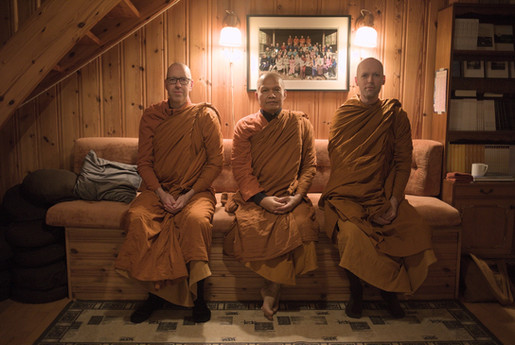
Before the onset of winter, Samanera Thitatto arrived from Wat Sumedharama in Portugal, while Ven. Athitjo traveled to further his Dhamma practice at Wat Dhammagiri in Brisbane, Australia. This winter, there are two monks residing at the monastery. Not counting the monks and novices who stay long-term to practice and help out, this year has been very conducive (sappāya) years yet—in terms of people, weather, food, and the environment. Although the snowfall has been light, the dry air and bright sunlight have allowed the snow to linger beautifully.




Activities and update
Almsroud
The monastery continues its regular morning alms rounds (Pindapata) throughout the winter at Vitee Thai in Sellebakk and Royal Thai in Fredrikstad.
New Year Blessings from Luang Por Wat Thai Norway
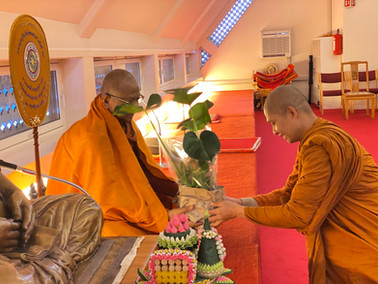
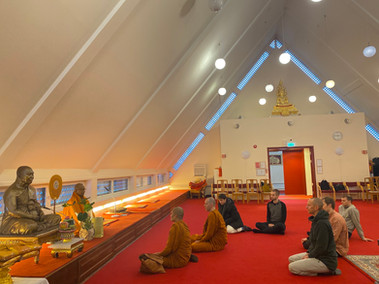
The Sangha and laypeople of Wat Pah Skiptvet visited the Abbot of Wat Thai Norway (Phra Rajvachirasasanavides) to receive New Year blessings. Luang Por kindly shared Dhamma teachings, with the core message being: "When one realizes they have a terminal illness, an unprecedented and intense fear of death arises. At that moment, we feel that no one can truly help us. No matter how skilled the doctors are, or how much support we receive from relatives and loved ones, ultimately, no one can save us.”





Meeting
Additionally, earlier this year, the monastery participated in a meeting with local religious leaders organized by the Askim Police Department. The discussion focused on establishing guidelines to prevent youth from being recruited into criminal activities through social networks.
Changes to Schedules and Activities
To improve management, the monastery has updated several activity dates and website details as follows:
Website Address: The official website will revert to https://skogskloster.no starting from the beginning of July.
One-Day Meditation Retreat: Changed from the first (or second) Saturday of the month to Sunday.
Monday Chanting: Renamed to "Evening Chanting" and moved to Tuesday evenings.
Saturday Online Dhamma Meditation: We are honored to have Ajahn Srisak, Ajahn Chanaphairi, and Ajahn Mahasombhop regularly lead the chanting and meditation sessions.
Furthermore, the monastery has launched online channels to allow those unable to visit in person to participate in the daily evening chanting sessions virtually.
Exhibition of Buddha Statues & Gestures: The Various Mudras
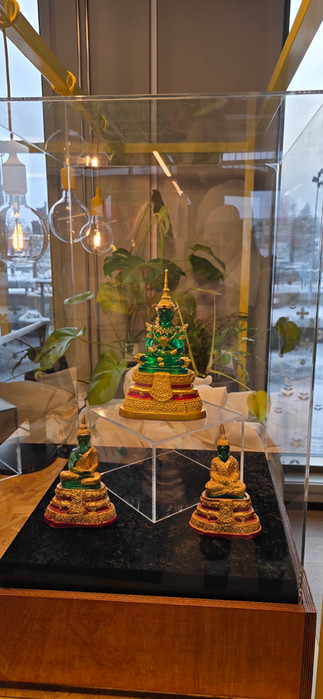
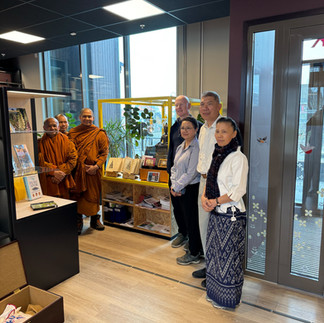
The monastery, in collaboration with Skiptvet Public Library, is hosting an exhibition featuring various postures and gestures (mudras) of the Buddha. This exhibition aims to provide an educational opportunity for those interested in the history and significance of these different forms. It serves as an extension of the exhibition previously held during the monastery’s 10th-anniversary celebration last October.
The exhibition has been running since January, featuring a different Buddha image each month:
January: The Emerald Buddha
February: The Walking Buddha (Leela)
March: The Buddha in the Jewelled House (Ruen Kaew)



The Highlight of April
April features the Mara Vijaya posture (The Victory over Mara). This month is particularly special, as the Culture History Museum in Oslo has graciously loaned a replica of the "Phra Mueang Fang." This Buddha image was brought to Norway 140 years ago by Carl Bock, a Norwegian explorer who traveled to Siam and documented his journey in the renowned book, “Temples and Elephants.” This piece will be on display from 13th to 25th of April.
Following this, from 25th to 30th of April, a replica of the Black Buddha of Nalanda will be exhibited. Carved from black stone from Nalanda, this image shares the same Mara Vijaya posture but offers a different perspective from the museum piece. We cordially invite everyone to experience the Black Buddha firsthand and connect with the history and faith it represents.





Coming in May
In observance of Vesak Day, which commemorates the Buddha’s Enlightenment, the exhibition will feature the Buddha in Meditation (Samadhi Mudra) throughout the month of May.
For more information and educational resources regarding the various Buddha postures presented by the monastery and Skiptvet Library, please visit https://www.lokuttara.net/statues-and-gestures
Songkrant
For this year’s Songkrant, our monastery was honored to welcome guest speakers from Santacittarama Buddhist Monastery in Italy, including Ajahn Preechar Jutindharo and Ven. Abhirak Ekaggacitto. We also welcomed a delegation from Vinngrom Buddhist Monastery in Lillehammer, led by Ajahn Sindre Ajito, accompanied by Ven. Marcus Indanyano and Anagariaka Silje Jayadhamma.
Morning Activities
The morning began with a variety of food stalls prepared by our volunteers to welcome the laypeople who gathered for the merit-making ceremony. Attendees participated in offering alms and food to the Sangha before sharing a meal together. The atmosphere was warm and friendly, just as it has been every year.
Ceremonies and Dhamma Desana
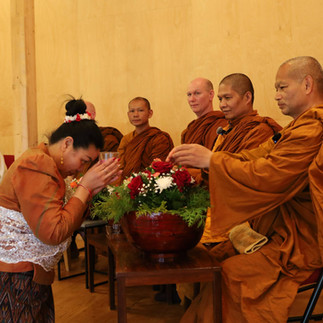
Following the morning’s Pha Pah (paṇsukula cloth and requisites) ceremonies, Ajahn Preecha and Ajahn Sindre delivered Dhamma talks in Thai and Norwegian, respectively. This was followed by the traditional Songkran water-pouring ceremony to request blessings from the monks and temple elders.
Listen to Ajahn Preechar’s talk in Thai Listen to Ajahn Sidre’s talk in Norwegian





Enshrinement of Luang Pu Chah
In a special highlight of the event, Ajahn Preecha—acting as a representative with the kind permission of Phra Brahmasidhi, the Abbot of Wat Saket—formally presided over the enshrinement of a statue of Luang Pu Chah at the altar in the Dhamma Hall.
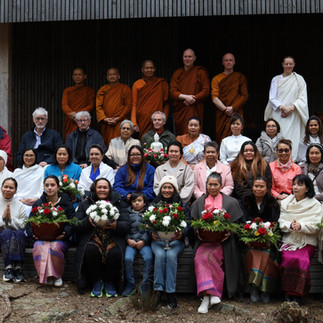
The day concluded with a commemorative group photo to mark the end of the ceremony.





Songkrant Blessings from the Luang Por Wat Thai Norway
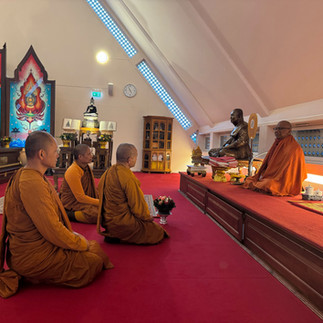
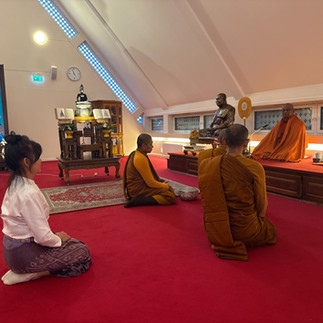
After completing the Songkran ceremonies at our monastery, the Sangha traveled to pay respects and receive New Year blessings from the Luang Por Wat Thai Norway (Phra Rajvachirasasanavides).
On this occasion, we also collected the "Phra Mueang Fang" image to be displayed at the Skiptvet Public Library exhibition. Additionally, Ajahn Preecha formally invited the Luang Por to visit Santacittarama Buddhist Monastery in Italy.



Dhamma reflection
Adapting for Happiness
Ajahn Kongrit
To live a sustainably happy life in society, one cannot, in practice, separate the worldly path from the spiritual path. By nature, simply declaring or believing that one is "not interested in Dhamma" does not grant a license to act purely as one pleases. This is especially true when living in a diverse society where people have different minds, opinions, and backgrounds. Naturally, we tend to feel untrusting or uncertain toward things that differ from what we are accustomed to—sometimes leading to resentment or even revulsion if those things feel alien, offensive, or irritating.
Particularly in multicultural societies, people around us may not speak their minds or express their feelings directly. This is often because they assume "everyone should know better," or even if they realize we are unaware, they refrain from speaking up to avoid conflict. They may feel it is not their place or not the right time to say anything, understanding that most people—just like ourselves—do not enjoy being contradicted or offended.
The irony is that while we ourselves dislike being offended, we are often the ones offending others—whether through our gestures, actions, or speech that is blunt, aggressive, or even vulgar and demeaning toward others. If such behavior occurred among troublemakers, it might be somewhat understandable as it is their nature. However, when it comes from leaders, authorities, or even within spiritual communities—those who present Dhamma to the public—it is quite jarring. What is even stranger is that a segment of society actually admires this behavior, perhaps perceiving it as "confidence," "decisiveness," or the sign of someone "detached from worldly conventions." Some may find it vicariously satisfying, while others are simply waiting to see "how long it can last."
“Solitude is happiness for one who is content, who has heard the Dhamma and clearly sees it. Non-harming—restraint toward all living beings—is happiness in the world. Dispassion—the overcoming of sensual desires—is happiness in the world. But the removal of the conceit 'I am' —that indeed is the highest happiness.” Ud 2.1: Mucalinda Sutta, Khuddaka Nikāya
From observation, however, those who claim to be indifferent to worldly conventions often "lose their cool" (Taba-taek) when the world treats them exactly the same way they treat others. To visualize this, it is like a driver weaving recklessly through traffic, cutting everyone off and acting as if everyone else on the road is a fool, only to wonder why others honk, glare, or shout insults at them. This doesn't even account for those who refuse to follow traffic rules yet demand and force others to make way for them. It is no wonder why people generally dislike or resent such individuals.
If we look to the Buddha as our example, the difference is clear. As a Great Being (sappurisa), his gestures and speech were beautiful in both wisdom and conduct. This beauty sprang from a peaceful mind (viveka), free from ill-will (abyāpāda), free from craving (virāga), and free from the conceit of self (asmi-māna)—the root cause of being bound to the world. Whether we say he was a Great Man filled with supreme happiness, or one who allowed no suffering to arise in his mind, the meaning is exactly the same.
Therefore, we must be perceptive and keep our "antennas" up—observing and learning to adapt to the unspoken social cues around us. At the very least, we must first learn to integrate into that society. If we intend to correct what is wrong or improve a situation, we must first earn the recognition that "this person understands the problem." Only then will others accept that "this person has wisdom" and open their hearts to listen. Otherwise, our words will be of little value and “fall on deaf ears” (lit. worth only a couple of pennies)—like "speaking for the sake of speaking" without any real impact.
Student visits
Visit to Asker Upper Secondary School
On the 24th of February, Phra Ajahn Kongrit, representing the Thai Buddhist Federation in Norway and coordinated by Phra Maha Kamsing and Ms. Sara, visited Asker Videregående Skole. He met with two groups of students, totaling approximately 80 participants, to deliver a lecture and host a Q&A session on the topic of “Ethics.”
The discussion focused on social acceptance and norms—what is deemed acceptable or unacceptable within a society even when not explicitly written as laws. The Ajahn emphasized that when entering a new environment, one must learn and adapt. He further explained that in Buddhism, Morality (Sīla) is not a commandment from a God; there is no divine figure to reward or punish. Rather, it is a guideline of what should or should not be done based on the law of cause and effect.
The students engaged with thought-provoking questions, such as: "Why must we suffer?", "Is it okay to like the practice but not yet desire Nirvana?", "In the cycle of rebirth, can we choose where we are born?", and "Can women achieve enlightenment?" The session concluded with a chanting of the Metta Sutta in English, which the students followed along. Small Emerald Buddha figurines were given as souvenirs, and Phra Maha Kamsing performed a traditional wrist-tying ceremony (blessing strings) for the students.
Dhamma Talk at the University of Oslo (UiO)
On April 9th, Phra Ajahn Kongrit was invited to give a Dhamma talk to the Wednesday meditation group at the University of Oslo. The teaching focused on the principle of "Being an island unto oneself," relying on oneself and the Dhamma as a refuge (an island), rather than seeking external refuges.
Listen the the talk (in English)
Visiting Students at Bytårnet School
On April 16th, Phra Ajahn Kongrit was invited by a Buddhist studies teacher to provide knowledge about Buddhism to approximately 25 seventh-grade students at Bytårnet Skole in Moss. This school is also where the Ajahn attends Norwegian language classes with the Thai Language and Culture Association every Saturday.



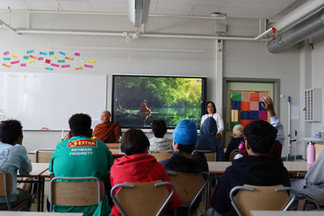


He taught the students about the nature of the mind, describing it as inherently luminous (pabhassara). He explained that when negative emotions arise, they should be viewed merely as "visiting guests." A well-directed mind brings more benefit and happiness than any friend or relative can provide. Conversely, a misguided mind causes more harm than any enemy. The session included a brief meditation trial. Although some students were not yet fully engaged, the Ajahn encouraged them, noting that even if they do not find interest now, these tools may be valuable in their future.
The teacher prepared blessing strings as souvenirs. Before offering that to them, the Ajahn explained that these strings serve as a reminder to view one another as friends—fellow travelers in the cycle of life and death—to promote harmony and prevent conflict among the children.
Special guest visit
At the beginning of February, Luang Por Nusin Santacitto from Wat Phisan Phothiyan in Nakhon Chai Si, Nakhon Pathom—a disciple of the late Luang Pu Chah—visited Wat Pah Skiptvet. He was accompanied by three other monks: Ajahn Prasert Thanavaro, Ajahn Phatchara Rocanavamso, and Ajahn Sarayut Papassaro. During the visit, Luang Por kindly delivered a Dhamma talk to the lay community before continuing his journey to Wat Buddha Dan Dhamma in Kvinesdal and eventually returning to Thailand.
Special guests coming to visit
Our monastery is honored to welcome several senior monks (Theras) visiting during June and July. The schedule is as follows:
6–9 June: LP Sucitto, former Abbot of Chithurst Buddhist Monastery, UK.
6–10 June: Ajahn Mettiko, senior monk from Muttodaya Forest Monastery, Stammbach, Germany.
12 June – 17 July: Ajahn Dhammiko from Wat Sumedharama, Ericeira, Portugal. Ajahn Dhammiko will also lead a Summer Retreat from 20–28 of June.
15–20 June: Ajahn Khemasiri, former Abbot of Dhammapala Buddhist Monastery, Kandersteg, Switzerland.
5–9 July: Ajahn Ahinṃsako, current Abbot of Chithurst Buddhist Monastery, UK.
5–13 July: Ajahn Dhammasiha, Abbot of Dhammagiri Forest Monastery, Brisbane, Australia.
We cordially invite everyone to come to the monastery to pay respects, make merit, or engage in Dhamma discussions with these senior monks on the dates mentioned above.

